
Climate Justice in Practice: Human Rights, Accountability and a Just Transition
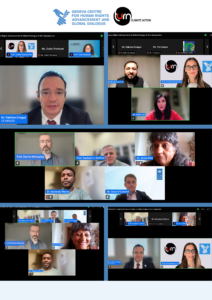 Geneva, 16 October 2026 – On 15 October 2026, the Geneva Centre for Human Rights Advancement and Global Dialogue, in partnership with the tUrn Climate Crisis Awareness & Action Project at Santa Clara University, convened the online symposium “Driving Climate Commitments toward a Just Transition: Human Rights, Law and Accountability in Action.” The event brought together international experts, public officials, academics and practitioners to examine how human rights and legal frameworks can help translate climate commitments into effective and equitable action.
The discussions highlighted a shared priority: climate action must go beyond ambitious targets to deliver practical results that protect people, address inequalities and ensure accountability.
Putting human rights at the centre of climate action
The high-level opening session featured H.E. Akram Saud Al-Harahsheh, Permanent Representative of Jordan to the United Nations in Geneva; H.E. David W. Panuelo, former President of the Federated States of Micronesia ; and Professor Elisa Morgera, UN Special Rapporteur on human rights and climate change. Moderated by Dr. Fabrice Crégut, Executive Director of the Geneva Centre, the session explored how States’ climate commitments can be translated into measures that respond to the needs of affected populations.
Ambassador Al-Harahsheh highlighted the challenges climate change poses to Jordan’s water resources and food security, emphasising the importance of adaptation and international cooperation. H.E. Panuelo stressed that, for Pacific island nations, climate change threatens not only livelihoods and human rights but also cultural heritage and the relationship between communities and the ocean. Professor Morgera underlined the need for science-based climate action that recognises the interdependence of human rights, health, water and nature, while addressing the responsibilities of private actors contributing to climate-related harm. She also highlighted the importance of making the health consequences of climate change more visible in public and policy debates, as evidence of these impacts can help build political momentum for action, particularly in contexts where powerful economic interests continue to support fossil fuel subsidies.
Connecting global commitments with local realities
The second panel, “Living Through – Human Rights and Climate Obligations with a Regional Focus,” moderated by Kristin Kusanovich, Director of tUrn Climate Action Project at SCU, explored how climate impacts and responses vary across regions. Contributions from Ms. Maria Zotti, Manager of Climate & Sustainability at the City of Unley, Australia, and Mr. Abdulhadi Achakzai, Founder and CEO of EPTDO, Afghanistan, highlighted the importance of locally grounded approaches, from inclusive community climate planning to supporting agricultural communities and food security.
The discussion stressed that local communities are already contributing to climate solutions, but need institutional support, adequate resources and meaningful opportunities to influence decisions. Participation must go beyond consultation to ensure that climate policies reflect the priorities and experiences of affected people.
Making the transition fair and accountable
The third panel, “Labour Justice, Development and the Just Transition,” examined how the transition towards sustainable economies can protect livelihoods and distribute its costs and benefits more fairly. Moderated by Professor Darren McCauley of Newcastle University, the panel brought together Mr. Seán O’Connell of UNDP, Dr. Kennedy Mbeva of the University of Cambridge, Dr. Sonia Dias of WIEGO, and Professor Raphael J. Heffron of Abu Dhabi University.
Participants highlighted the importance of meaningful participation in policy design, measurable goals and clear accountability. A just transition requires effective institutions and adequate resources, while ensuring that workers and communities are not left to bear disproportionate costs. The discussion also underscored the value of multi-stakeholder processes in shaping inclusive and lasting policy change.
From commitments to action
Across the three panels, four priorities emerged:
- People-centred climate action: Protect human rights, livelihoods, health and access to essential resources.
- Meaningful participation: Enable affected communities to shape decisions and contribute to locally grounded solutions.
- Effective accountability: Translate commitments into measurable objectives, clear responsibilities and concrete implementation.
- International solidarity: Ensure that countries and communities facing significant climate risks receive the support needed to strengthen resilience and pursue sustainable development.
The symposium highlighted the importance of connecting international legal frameworks with regional experience and community-led action. Ultimately, a just transition is about more than transforming economies: it is about protecting human dignity, safeguarding livelihoods and ensuring that the move towards a sustainable future benefits present and future generations.